The American symbolist painter Elihu Vedder (1836-1923) spent part of his childhood in Cuba. After a while his parents thought the climate too hot for his health, and he was sent back to the care of his grandparents in New York. As he writes in his memoir The Digressions of V. , he left one particular friend behind him: ...I began to look sallow, and was packed off North. But I left one broken heart behind me, that of poor Cottorita, my parrot. She had been given me very young, and loved as only a parrot or dog can love. I have always been sorry that I did not take the dear thing with me, for she went about for three days after my departure, calling, " Nino Elijio! Nino Elijio! " and then flew away and was never seen again. When I went to the Spanish school she would station herself at the house-door and wait patiently until I came back, and then, climbing up, never quitted my shoulder. When I remember that a parrot can live a hundred years, there is no reason why she ...
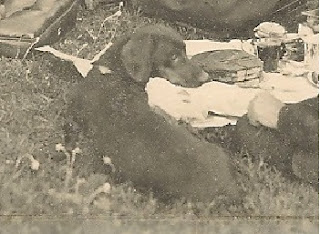
detail from a photo in the museum collection Did you already hear about the new dachshund museum in Germany? (Probably from the Smithsonian article ?) The Smithsonian does not provide a link to the website, but that's why you have me: Dachshund Museum . I've sent you to the English version of the site, but it hasn't been completely translated. FYI.
From a 20th-century collection of 1200 Russian proverbs comes this selection, none of which I think I've seen before. Manure does not shame the field. The horse is often wiser than its rider. A stupid dog is not a tiger. The dog that likes to eat partridges is of no use to the hunter. If you deal with dogs, learn how to bark. The cat saw the camel and immediately arched its back. Old mice like fresh lard. If the cat can't eat the fish with its mouth, it will eat it with its eyes. ( Too true - curator ) A wet poodle does not fear water. -- Langnas, Izaak Abram, 1911-. 1200 Russian Proverbs. New York: Philosophical Library, 1960. Passim.


Comments
Post a Comment